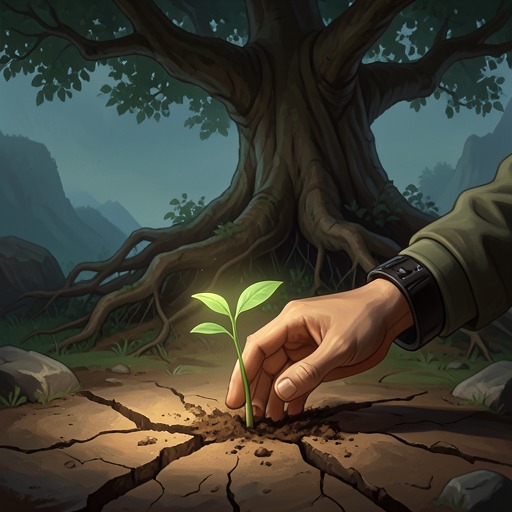
Law of Sowing and Reaping
Don't Leave God Alone: How to Get God's Attention, Remain in His Presence, and Even Change His Mind to Make a Difference in Your WorldThe Law of Sowing and Reaping is the book’s central account of how actions become outcomes. It treats prayer, sacrifice, generosity, obedience, righteous choices, and faith-filled speech as seeds whose effects may not appear immediately but can grow into blessing, answered prayer, changed character, healing, financial provision, and expanded ministry. The rule therefore joins patience to responsibility: a harvest requires both what is planted and the persistence to tend it until it matures.
Definition and Spiritual Operation
The law begins with the conviction that every harvest starts with seeds. In the book’s most sustained image, persistent prayer and sacrifice fill a “rain cloud of blessing,” comparable to a heavenly bank account. As prayer, giving, and sacrificial service supply spiritual “moisture,” the cloud becomes full and eventually releases rain. The image makes blessing a process rather than an isolated surprise: what seems like delay may be the period in which the cloud is being filled.
The same image explains spiritual dryness. A desert receives little rain because there is little moisture rising from the ground; likewise, the book associates a life marked by little prayer and no sacrifice with an unfilled cloud of blessing. Giving is presented as part of this continuing cycle, with the measure given linked to the measure returned. The expected result is not merely a single answer but an overflowing impact, like a water balloon filled enough to drench whatever it strikes.
The rule also requires waiting. The book describes “seed, time, and harvest” as a sequence in which impatient people try to inspect or accelerate their answers, thereby interrupting the growth process. Jesus’ teaching in Mark 4 is used to emphasize that the seed sprouts and develops while the sower does not control the hidden mechanics of its growth. Once seeds have been planted, praise, testimony about God’s promises, rejoicing, and patient endurance serve as ways of watering them until harvest time.
What Counts as a Seed
Seed sowing is defined broadly as making God’s kingdom a priority and giving oneself to God in every available way. Financial offerings are one form of seed, but time spent serving the body of Christ and time spent privately in prayer are also treated as acts of sowing. The governing measure is not a single transaction but a lifestyle described as wholly committed to God and His kingdom.
The book applies the law especially to healing and finances, identifying them as two dominant areas in which people need prayer and a harvest of blessing. It rejects the claim that money itself is evil, distinguishing material resources from the love of money and from the criminal or selfish uses to which people may put them. In this framework, financial blessing can be requested confidently when God remains the first love and money is used righteously.
The text then gives money five permitted and required orientations: it must not produce arrogance, it must not become an object of trust, it may be enjoyed, it must be used for good, and it must be shared generously. Tithes and offerings are placed within this moral framework, as are good deeds and willing generosity. The right to enjoy nice things is therefore presented alongside restrictions against self-indulgence and forgetfulness of God. The law does not treat prosperity as an isolated entitlement; it makes the condition of the heart and the purpose of the resources part of the harvest’s legitimacy.
Prayer, Speech, and Persistent Action
The rule is illustrated through a church that faced the sudden loss of its meeting place. A neighboring office complained about the noise produced by Sunday worship with drums and guitars, and the property manager announced that the church would have to move within only a few days. The members prayed for direction and refused to give up. At the last moment, an uninvolved business professional negotiated on their behalf, and the manager offered another space in the same strip mall. Although the replacement was larger and more expensive, the church eventually grew from one small bay to three bays and later to seven times the original space. The episode turns persistent prayer into an image of expansion: what first looked like eviction became an enlargement of vision.
The same logic appears in the account of a brand-new luxury car. After returning tired from a ministry trip, Hank Kunneman initially resisted a persistent visitor who insisted on coming to see him. The visitor eventually arrived, handed him the keys, and said, “It’s yours.” Hank Kunneman and Brenda Kunneman were speechless, and the gift could either be driven or exchanged for something else. The immediate obstacle was not lack but the recipient’s hesitation, including thoughts that he did not deserve the gift and concern about how others would judge it. The story is used to argue that prolonged deprivation can form an identity of unworthiness, causing people to abandon the blessing before receiving it.
Persistence also protects against partial obedience. In the account of Jesus’ miraculous catch of fish, Jesus told Peter to let down his nets, but Peter lowered only a single net after a tiring and unproductive night. He still received a great multitude of fish, yet the book presents his incomplete response as an example of settling for less than the full benefit available through obedience. The Law of Sowing and Reaping therefore measures not only whether someone acts, but whether the action corresponds fully to the instruction received.
Speech is treated as another active form of sowing. The book connects faith-filled words with authority over obstacles, invoking the command that a great mountain become a plain and Elijah’s declaration that there would be no dew or rain “according to my word.” It also recounts a conference held during a drought overseas, where Hank Kunneman prophesied that rain would come within twenty-four hours as a sign of answered prayer and that thunder would carry God’s voice. For hours nothing seemed to happen, and the following day’s sun intensified his concern; later, however, clouds formed, heavy rain flooded the streets, and thunder shook the buildings. The event is presented as confirmation that declared words can participate in changing circumstances when spoken in faith.
Righteousness and the Harvest of Character
The law applies inwardly as well as materially. “Sow to yourselves righteousness” is interpreted as a continual practice of planting small seeds through right living, right thinking, right attitudes, and right choices. Each daily decision contributes to a future character that increasingly resembles Christ. Lasting fruit cannot be obtained by a single emotional resolution; it grows from repeated choices and discipline.
This emphasis distinguishes repentance from repeated apology. Hank Kunneman describes struggling with a wrong attitude toward another believer and repeatedly telling God that he was sorry without permanently intending to change. The correction he received was that God was seeking repentance rather than another apology. Repentance means rejecting the sin, changing direction, and producing a life that demonstrates the change. The book links this teaching to John the Baptist’s call for fruits worthy of repentance: visible fruit requires earlier seeds, and durable transformation depends on daily decisions not to continue in sin.
The account of blind Bartimaeus supplies the practical pattern. His movement from discouragement and darkness toward healing began with a decision to cry out to Jesus and continue until circumstances changed. In contrast, the story of Eli warns that failure to make day-to-day corrective choices can allow wrongdoing to continue. Eli’s undisciplined sons repeatedly sinned openly, and Eli did not undertake the daily action necessary to bring change. The harvest of character is thus shaped by what a person repeatedly tolerates as much as by what that person publicly professes.
The book’s weed-pulling memory makes the same point through physical labor. Hank Kunneman and his brother were paid by the box to remove weeds from a rocky hillside, but they pulled only the tops to finish more quickly. Their father’s employer asked, “Where are the roots?” Because the roots remained, the weeds grew back, exhausting them in the summer heat. Spiritually, shortcuts produce recurring defeat: surface regret cannot replace confronting the source of a problem. The proper preparation for flowers is to remove the weeds by the roots, just as righteous seeds must reach the underlying choices and attitudes that govern conduct.
Significance and Limits Within the Book’s Argument
The Law of Sowing and Reaping gives the book a unified explanation for delayed answers, expanding provision, spiritual formation, and persistent prayer. Moses’ refusal to accept the destruction of Israel is treated as a seed of intercession that moved God toward mercy; Elijah’s seventh prayer produced a cloud initially no larger than a man’s hand before rain poured down; and David’s attitude toward Goliath models the confidence required to confront a mountain rather than submit to intimidation. Across these examples, endurance is not passive waiting but continued participation through prayer, speech, obedience, giving, and resistance to discouragement.
At the same time, the rule assigns responsibility to the believer. A person who abandons prayer after failure is said to run away from God in shame, much as Adam and Eve hid after disobeying. The prescribed response is not withdrawal but return, repentance, and renewed cultivation. The law consequently functions as both promise and discipline: it assures readers that planted faith is not wasted, while requiring them to examine what they are planting, how faithfully they are tending it, and whether their desired harvest is governed by generosity, obedience, and a right relationship with God.